Published in Journal of Hepatology, the CHANCE study provides the first global prospective evidence on outcomes following liver transplantation in patients with severe ACLF. The landmark research demonstrates a substantial survival benefit for liver transplant patients, while identifying higher post-transplant mortality risk for patients with five or six organ failures.
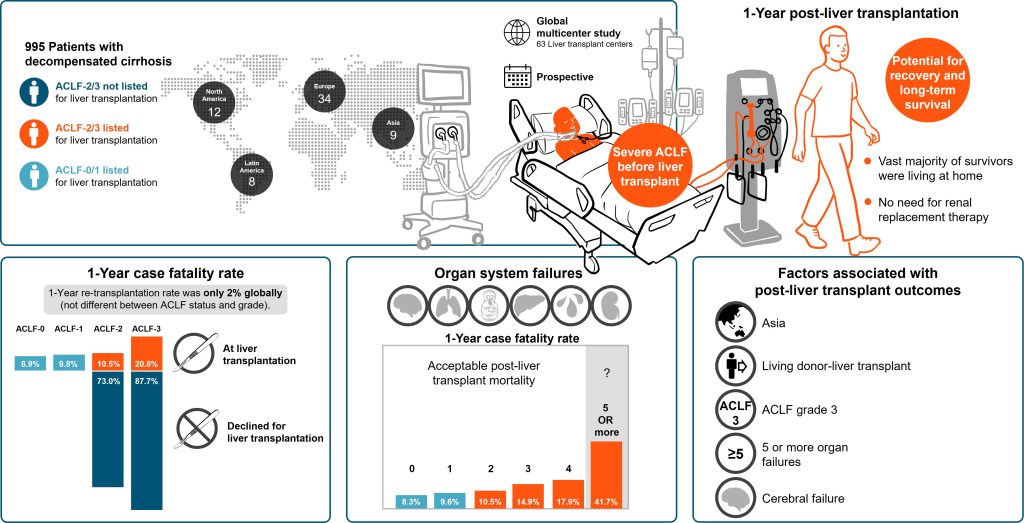
The CHANCE study prospectively followed 995 patients at 63 liver transplant centers across Asia, Europe, Latin America and North America between 2021 and 2023. Among them, 612 underwent liver transplantation, while 144 patients with ACLF-2 or ACLF-3 were declined for transplantation and were followed for one year.
The difference in outcomes was substantial: 73% of patients with ACLF-2 and 88% of patients with ACLF-3 who were declined for transplantation died within one year. By comparison, among transplanted patients, the one-year case-fatality rate without re-transplantation was just 10.5% for ACLF-2 — no different from that of transplanted patients without ACLF (9%) — and 20.7% for ACLF-3.
These observations highlight the immediate, real-world impact of liver transplantation on patient outcomes. “Liver transplantation dramatically improves survival in patients with severe ACLF compared to being declined for transplant. These results show that even very sick patients with cirrhosis can have a meaningful chance of survival following transplantation”, said Thierry Gustot, Principal Investigator of the CHANCE study, Head of the Transplantation and Organ Retrieval Department and Director of the Liver Transplant Unit at HUB Hôpital Erasme, Université Libre de Bruxelles, Brussels, Belgium.
Previous research on liver transplantation in severe ACLF has largely come from retrospective registries or small single-center series of patients from individual regions. The CHANCE study was designed to address these limitations by collecting prospective, standardized clinical data across a global network of liver transplant centers.
“For many years, ACLF has been considered a contraindication for liver transplantation. Complex intensive care unit management and the unfavorable clinical outcomes observed in early local series contributed to reinforcing this negative perception”, said Javier Fernández, Co-Principal Investigator of the CHANCE study, Head of Clinical Operations at EF CLIF, and Head of the Liver Intensive Care Unit in the Liver Unit at Hospital Clinic de Barcelona, Barcelona, Spain.
The inclusion of 63 centers across four continents allowed investigators to directly examine patient outcomes across different healthcare settings before liver transplantation and throughout one year of follow-up.
“Previous single-center and registry-based studies suggested a significant improvement in survival among patients with ACLF undergoing liver transplantation. As the largest prospective investigation conducted to date in this field, the CHANCE study confirms these positive results on a global scale, allowing for their generalization”, added Fernández.
While the findings support the benefit of liver transplantation in severe ACLF, they also provide important information about where the limits of transplantation may lie.
Among transplanted patients, one-year case-fatality rate increased progressively with the number of organ failures present at the time of liver transplantation. The rate was 8.3% in patients without organ failure, 9.6% with one organ failure, 10.5% with two, 14.9% with three, and 17.9% with four organ failures. In patients with five or six organ failures, however, the case-fatality rate rose to 41.7%. The analysis also found that certain types of organ failure were associated with higher post-liver transplant mortality, particularly brain, respiratory and circulatory failure.
“These findings show for the first time, prospectively and across four continents, that survival after liver transplantation in severe ACLF is governed not simply by the ACLF grade itself, but by the number and type of failing organs at the moment of surgery”, said Rajiv Jalan, Scientific Coordinator of the CHANCE study, Professor of Hepatology at the Institute for Liver and Digestive Health, University College London, and Consultant Hepatologist at the Royal Free Hospital, London, UK.
The findings point towards a more individualized assessment of patients with the most severe forms of ACLF, based on the number and type of organ failures rather than on ACLF grade alone. This distinction is important when considering both the potential benefit of liver transplantation and the appropriate use of scarce donor organs. “Too many patients with severe ACLF have been denied a transplant based on fear rather than evidence, and equitable access to transplantation for these patients is now a moral imperative. Because donor organs are a scarce and precious resource, the data should reassure surgical and medical colleagues that liver transplantation can be undertaken safely in patients with up to four organ failures and justify prioritizing them, while recognizing that once five or six organs have failed the chance of benefit falls sharply and each decision demands great care”, added Jalan.
The results provide transplant teams with evidence to help assess patients with ACLF-2 and ACLF-3 and identify those most likely to benefit from liver transplantation, offering a practical framework for managing scarce donor organs.
“The CHANCE study has confirmed that for selected patients with very severe ACLF we now have a treatment that is both practical and lifesaving. Its findings will help us to identify who the patients most likely to benefit from liver transplant are, so that we can most effectively use the limited number of liver grafts available”, said William Bernal, Co-Principal Investigator of the CHANCE study, Professor of Liver Critical Care Medicine at King’s College London, and Consultant in Liver Critical Care in the Liver Intensive Therapy Unit at the Institute of Liver Studies, King’s College Hospital, London, UK.
The study also found that patients with ACLF-2 or ACLF-3 on the liver transplant waiting list had almost twice the risk of death or delisting because of clinical deterioration than patients without severe ACLF (27% versus 15%), despite shorter waiting times. “This reinforces the importance of timely assessment and supports the prioritization of selected patients in organ allocation systems, as has already been piloted successfully in the United Kingdom“, added Bernal.
At the same time, the authors emphasize that the findings should not be interpreted as support for liver transplantation in every patient with severe ACLF. The markedly poorer outcomes observed in the relatively small group of transplanted patients with five or six organ failures highlight the importance of carefully assessing the balance between potential benefit and risk in the most critically ill patients.
Beyond the clinical implications of the findings, the CHANCE study has established an international infrastructure for prospective data and biological sample collection. The study brought together 63 liver transplant centers using harmonized procedures and collected clinical information in addition to blood, plasma, urine and DNA samples.
This collective effort represents an important milestone for global clinical research. “CHANCE demonstrates what can be achieved when liver transplant centers across the world work together using harmonized procedures for prospective data and sample collection”, said Cristina Sánchez-Garrido, Head of the Data Management Center at EF CLIF, Barcelona, Spain. “Coordinating such a large international network has required a major collective effort, but at the same time it has allowed us to build a high-quality, standardized dataset and biobank that would not have been possible at the level of individual centers.”
The resulting dataset and biobank will provide a foundation for further studies. “Beyond its immediate clinical findings, the CHANCE study establishes a unique infrastructure whose value will continue to grow well beyond publication”, said Gustot. “By combining detailed, prospectively collected clinical phenotyping with paired biological sampling — blood, plasma, urine, and DNA — across 63 centers worldwide, the CHANCE cohort offers an unprecedented resource for understanding ACLF and its response to liver transplantation”.
Other authors in the study are Eva Usón-Raposo, Juan Manuel Díaz, Alberto Queiroz Farias, Ashwin Rammohan, Sebastián Marciano, Alexander Kuo, Giovanni Perricone, Rebecca Bateman, Luis Bagulho, Sudhindran Surendran, Jordi Colmenero, Manuel Mendizabal, Nyingi Kemmer, Juan F. Gallegos-Orozco, Nazia Selzner, Laure Elkrief, Christina C. Lindenmeyer, Prasun K. Jalal, Margarita Anders, Valerio Lucidi, Carmen Vinaixa Aunés, Luca Vizioli, Krzysztof Zieniewicz, Andrea della Penna, Angelo Z. Mattos, Michael Kriss, Pietro Lampertico, Livia Melo Carone Linhares, Carmine Gambino, Graciela Elia Castro-Narro, Caroline den Hoed, Kirti Shetty, Tasneem Pirani, Baptiste Giguet, Baptiste Michard, Helen S. Te, Sezai Yilmaz, Neeraj Saraf, Abhishek Chauhan, Takanobu Hara, Rosa Martin-Mateos, Fanny Lebossé, Takeo Toshima, Wim Laleman, Maximilian Joseph Brol, Isabel Campos-Varela, Emmanuel Weiss, Hideki Ohdan, Felix Braun, Constantine J. Karvellas, Marie Sinclair, Cornelius Engelmann, Joanna Moore, Audrey Coilly, Carmelo Loinaz, Georges-Philippe Pageaux, Hans van Vlierberghe, Ken Liu, Michael John Williams, Chee Chien Yong, Lance L. Stein, Juan-Carlos Restrepo, Kiyoshi Hasegawa, Gabriela Berlakovich, Patricia Momoyo-Zitelli, Dinesh Jothimani, Nicholas N. Nissen, Federico d’Amico, Filipe S. Cardoso, Zubair Umer Mohamed, Pablo Ruiz, Josefina Pages, Kiran Dhanireddy, Ephrem Salamé, Bijan Eghtesad, Megha Bhongade, Julia Brutti, Antonella Putignano, Eva Montalvá-Orón, Roberto di Donato, Joanna Raszeja-Wyszomirska, Maria Lúcia Zanotelli, Luiz Augusto Carneiro d’Albuquerque, Subathra Radhakrishnan, Jorge Martinez, Juvelyn Palomique, Hugo P. Marques, Anna Paul, Giulia Pagano, Richie Alexander Inge-Cox, Flair José Carrilho, Catherine Ann Martin, Gonzalo Gomez Perdiguero, Wellington Andraus, Adrian Gadano, Mohamed Rela, Rachel H. Westbrook, Marina Berenguer, Silvio Nadalin, Christophe Duvoux, Luca Saverio Belli, Vinay Sundaram, Yaman Tokat, Wojciech G. Polak, Constantino Fondevila, Susumu Eguchi, Geoffrey McCaughan, Elizabeth Pomfret, Anna Bosch, Joan Clària, Paolo Angeli, Jonel Trebicka, Didier Samuel, Richard Moreau, Vicente Arroyo; and Investigators of the CHANCE study group.
Gustot T, Bernal W, Fernández J, et al. Prospective study of the outcomes of liver transplantation in patients with acute-on-chronic liver failure. J Hepatol 2026. DOI: 10.1016/j.jhep.2026.09.015
European Foundation for the Study of
Chronic Liver Failure
Avinguda Diagonal 477, 11th floor
08036 Barcelona, Spain
Tel: +34 93 227 14 00
Email: Send us an email
© 2025 European Foundation for the Study of Chronic Liver Failure

| Cookie | Duration | Description |
|---|---|---|
| cookielawinfo-checkbox-analytics | 11 months | This cookie is set by GDPR Cookie Consent plugin. The cookie is used to store the user consent for the cookies in the category "Analytics". |
| cookielawinfo-checkbox-functional | 11 months | The cookie is set by GDPR cookie consent to record the user consent for the cookies in the category "Functional". |
| cookielawinfo-checkbox-necessary | 11 months | This cookie is set by GDPR Cookie Consent plugin. The cookies is used to store the user consent for the cookies in the category "Necessary". |
| cookielawinfo-checkbox-others | 11 months | This cookie is set by GDPR Cookie Consent plugin. The cookie is used to store the user consent for the cookies in the category "Other. |
| cookielawinfo-checkbox-performance | 11 months | This cookie is set by GDPR Cookie Consent plugin. The cookie is used to store the user consent for the cookies in the category "Performance". |
| viewed_cookie_policy | 11 months | The cookie is set by the GDPR Cookie Consent plugin and is used to store whether or not user has consented to the use of cookies. It does not store any personal data. |