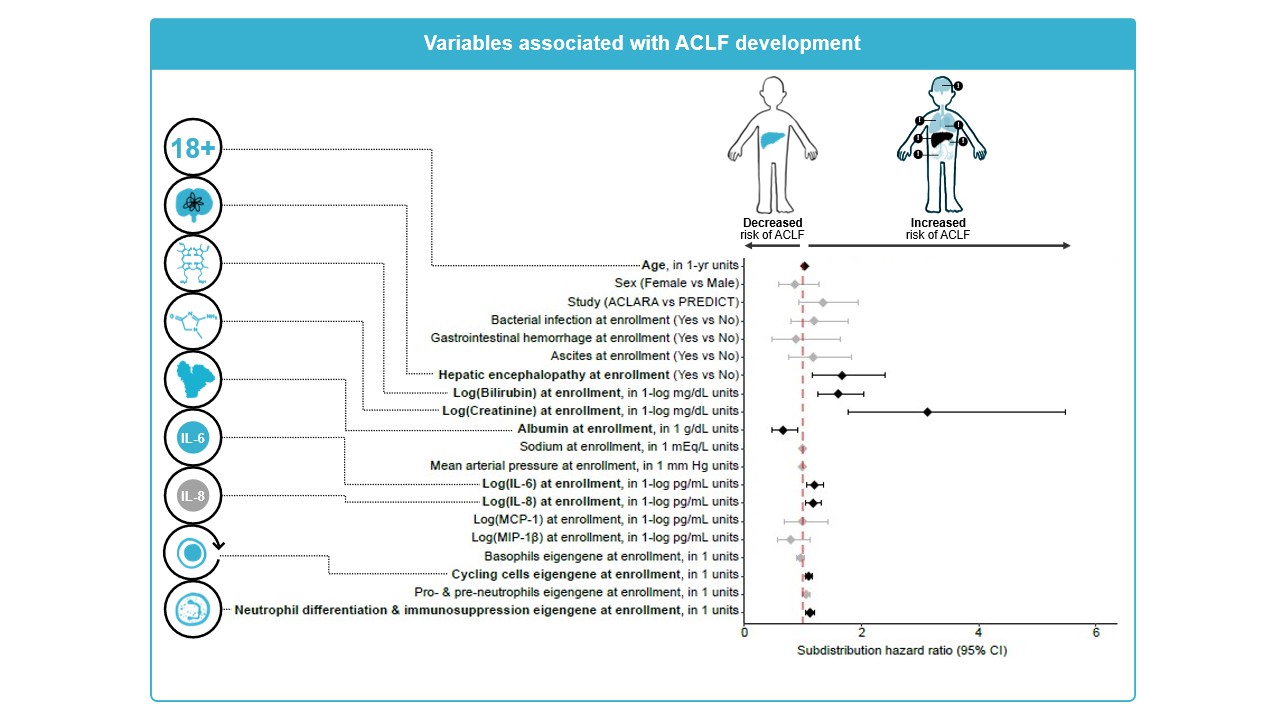
Researchers analyzed whole-blood RNA sequencing data from 1260 patients enrolled in the PREDICT and ACLARA studies. “We perfomed an exhaustive exploration using all processed available bioinformatic data to the groups of correlated genes (modules) to determine which blood cell types were mostly implicated in the cases with the poorest outcomes”, said Juan Jose Lozano from Centro de Investigación Biomédica en Red de Enfermedades Hepáticas y Digestivas (CIBEREHD), Instituto de Salud Carlos III, Spain.
This analysis pipeline uncovered that patients defined as having “pre-ACLF” at admission (this is, those who developed ACLF by 28 days) and non-survivors (this is, those who died within 90 days after admission), exhibited marked signs of emergency granulopoiesis activation—characterized by increased neutrophil production and activation of the IL-6–STAT3–C/EBPB signaling axis. In these patients, this immune response appeared maladaptive, leading to an overproduction of immature and immunosuppressive neutrophils associated with higher risk of infection and mortality.
“Even before ACLF develops, we can detect distinct transcriptional features in circulating immune cells that reflect this amplified and dysregulated granulopoietic response,” explained Richard Moreau, senior author in the paper and Director of EF CLIF, Spain. “This suggests that changes in immune blood cell production itself contribute to disease progression”, he added.
Using gene co-expression network analysis, the researchers identified two gene modules—one linked to neutrophil differentiation and immunosuppression, and another to cycling cells—that independently predicted the risk of developing ACLF.
These findings shed light on why some patients experience rapid deterioration despite similar clinical presentations at hospital admission. They also suggest that routine blood transcriptomic profiling might help identify patients at risk for ACLF and guide the design of preventive therapeutic strategies.
“Our data support a two-tier strategy for early identification of patients at risk of ACLF: (1) A flow cytometry-based detection of rare immature neutrophils as an immediately applicable bedside biomarker, and (2) the development of a gene expression panel capturing maladaptive emergency granulopoiesis and cell cycling, implementable on targeted platforms and combinable with existing prognostic scores to refine risk stratification on admission”, said Ferran Aguilar, co-first author in the paper and bioinformatician at EF CLIF.
The study further suggests that IL-6 plays a central role in the maladaptive activation of emergency granulopoiesis and release of neutrophils with abnormal, immunosuppressive properties from the bone marrow into the bloodstream in patients with poor outcomes. This finding raises the possibility that therapies modulating IL-6 pathways—already used in other inflammatory diseases such as severe COVID-19, or sepsis—might hold promise for preventing ACLF in high-risk patients.
“Our current efforts focus on testing whether therapeutic targeting of the IL-6–STAT3–C/EBPβ signaling axis can mitigate the pathological myelopoiesis and immunosuppression observed in patients with end-stage liver disease”, said Joan Clària, co-first author in the paper, Director of the Grifols Chair and Head of Translational Operations at EF CLIF, and Group Leader of the Inflammation and Liver Disease group at Hospital Clínic de Barcelona-Institut d’Investigacions Biomèdiques August Pi i Sunyer (IDIBAPS), Spain.
Despite using bulk whole blood RNA sequencing rather than single-cell approaches, the large size and multi-cohort design of the study make it the most comprehensive analysis to date of immune dysregulation in decompensated cirrhosis.
“Our results triangulate on hematopoietic tissues as foundational for the maladaptive response to different stresses among patients with acutely decompensated cirrhosis who have poor outcomes. This maladaptive response may contribute to poor outcomes because it results in the production of immunosuppressive neutrophils that may play a role in the development of deadly infections. It is tempting to hypothesize that targeting mechanisms underpinning the maladaptive response would prevent the progression of the disease towards more severe stages. Addressing this question will be a priority within EF CLIF’s research agenda in the coming years”, concluded Richard Moreau.
Other authors in the study are Juan José Lozano, Sara Noemi Reinartz Groba, Mathis Richter, Laura Jiménez-Gracia, Pierre de la Grange, Ariane Jolly, Michael Praktiknjo, Cristina Sánchez-Garrido, Eva M. Uson Raposo, Beatriz García-Torre, Wim Laleman, David Gómez-Cabrero, Sara Palomino-Echeverria, Estefania Huergo Iglesias, Alberto Queiroz Farias, Sebastián Marciano, Paolo Caraceni, Jonel Trebicka, Andrea Cerutti, Vicente Arroyo, Holger Heyn, Juan C. Nieto, Oliver Soehnlein, and Pierre-Emmanuel Rautou.
Joan Clària is supported by Centro de Investigación Biomédica en Red de Enfermedades Hepáticas y Digestivas (CIBEREHD), Instituto de Salud Carlos III, Spain.
Ferran Aguilar, Juan José Lozano, Joan Clària, Sara Noemi Reinartz Groba, Mathis Richter, Laura Jiménez-Gracia, Pierre de la Grange, Ariane Jolly, Michael Praktiknjo, Cristina Sánchez-Garrido, Eva M. Uson Raposo, Beatriz García-Torre, Wim Laleman, David Gómez-Cabrero, Sara Palomino-Echeverria, Estefania Huergo Iglesias, Alberto Queiroz Farias, Sebastián Marciano, Paolo Caraceni, Jonel Trebicka, Andrea Cerutti, Vicente Arroyo, Holger Heyn, Juan C. Nieto, Oliver Soehnlein, Pierre-Emmanuel Rautou, Richard Moreau, on behalf of the DECISION Consortium. Maladaptive emergency granulopoiesis characterizes patients with poor outcomes among those admitted for decompensated cirrhosis. J Hepatol 2025. DOI: 10.1016/j.jhep.2025.11.012

This study received funding from the European Union’s Horizon 2020 research and innovation programme under grant agreement no. 847949.
European Foundation for the Study of
Chronic Liver Failure
Avinguda Diagonal 477, 11th floor
08036 Barcelona, Spain
Tel: +34 93 227 14 00
Email: Send us an email
© 2025 European Foundation for the Study of Chronic Liver Failure

| Cookie | Duration | Description |
|---|---|---|
| cookielawinfo-checkbox-analytics | 11 months | This cookie is set by GDPR Cookie Consent plugin. The cookie is used to store the user consent for the cookies in the category "Analytics". |
| cookielawinfo-checkbox-functional | 11 months | The cookie is set by GDPR cookie consent to record the user consent for the cookies in the category "Functional". |
| cookielawinfo-checkbox-necessary | 11 months | This cookie is set by GDPR Cookie Consent plugin. The cookies is used to store the user consent for the cookies in the category "Necessary". |
| cookielawinfo-checkbox-others | 11 months | This cookie is set by GDPR Cookie Consent plugin. The cookie is used to store the user consent for the cookies in the category "Other. |
| cookielawinfo-checkbox-performance | 11 months | This cookie is set by GDPR Cookie Consent plugin. The cookie is used to store the user consent for the cookies in the category "Performance". |
| viewed_cookie_policy | 11 months | The cookie is set by the GDPR Cookie Consent plugin and is used to store whether or not user has consented to the use of cookies. It does not store any personal data. |